OCEANICA 7
- Published in News
Nos dias 14,15 e 16 de outubro realizou-se o IV Meeting Report(h)a subordinado ao tema “Sapiens, Saúde e Meio Ambiente: fonteiras naturais e artificiais”. O Congresso foi promovido pelo Centro de História da Sociedade e da Cultura (CHSC) a que se associaram, em parceria, outros centros e projetos: Centro de Ecologia Funcional (CEF), Centro de Geografia e Planeamento do Território (CEGOT), Centro de Investigação em Antropologia e Saúde (CIAS), Centro de estudos Sociais (CES) e o projeto ReSEED - Rescuing Seed’s Heritage. Contou ainda com a colaboração da REPORT(H)A e foi acolhido pelo Instituto Interdisciplinar da Universidade de Coimbra (iiiUC). O Encontro realizou-se à distância. Participaram quatro convidados que proferiram conferências subordinadas às temáticas centrais do colóquio e 70 oradores que apresentaram comunicações organizadas em painéis ou em sessões temáticas. Esta quarta edição de encontros Report(h)a deu continuidade aos objetivos desta rede em termos de interdisciplinaridade, ou mesmo de transdisciplinaridade e de internacionalização – contou com participantes pertencentes a mais de 80 centros de investigação, universidades nacionais e internacionais e de vários países: Portugal, Brasil, Espanha, Moçambique, Marrocos, Índia, França, Roménia, Perú, EUA e Suécia. Investigadores de várias proveniências partilharam o seu saber sobre temáticas de grande atualidade (relação do humano com a natureza, sistemas alimentares, biodiversidade, sustentabilidade, doenças decorrentes de problemas ambientais). Tiveram ainda voz ecologistas que alertaram para más práticas de interação com a natureza.
-----------------------------------------------------------------------------------------------------------
On the 14th, 15th and 16th of October, the IV Meeting Report(h)a took place under the theme “Sapiens, Health and Environment: natural and artificial fountains”. The Congress was promoted by the Center for the History of Society and Culture (CHSC) in collaboration which other research centers and projects: Center for Functional Ecology (CEF), Center for Geography and Territorial Planning (CEGOT), Center for Research in Anthropology and Health (CIAS), Center for Social Studies (CES) and the Rescuing Seed's Heritage project (ReSEED). It also had the collaboration of Report(h)a and was hosted by the Interdisciplinary Institute of the University of Coimbra (iiiUC). The Meeting took place online. Four speakers gave lectures on the main themes of the colloquium and 70 speakers presented papers organized in thematic sessions. This IV edition of Report(h)a meeting continued its goals in terms of interdisciplinarity, transdisciplinarity and internationalization – with participants from more than 80 national and international research centers and universities from several countries: Portugal, Brazil, Spain, Mozambique, Morocco, India, France, Romania, Peru, USA and Sweden. Researchers from various backgrounds shared their knowledge on current topics (relation between humans and nature, food systems, biodiversity, sustainability, diseases resulting from environmental problems). The voice of ecologists warned about the current scenario of dangerous interaction between humans and nature.
A REPORT(H)A chegou ao Instagram!
Sigam @rede.reportha e partilhem as vossas notícias, projetos e trabalhos. Podem enviar toda a informação que queiram ver publicada - tanto na Newsletter como na rede social - para This email address is being protected from spambots. You need JavaScript enabled to view it.
Relembramos que no webiste da REPORT(H)A podem encontrar uma secção dedicada a estórias da História Ambiental (https://www.reportha.org/en/stories) para a qual vos convidamos a contribuir com reflexões ou comentários a livros, filmes, música, fotografias, relatórios, comunicações de projetos ou trabalhos académicos.
--------------------------------------------------------------------
REPORT(H)A is on Instagram!
Follow us on @rede.reportha and share your news, ongoing projects and ideas. You can send us the information you want to share - in the newsletter or social media - to This email address is being protected from spambots. You need JavaScript enabled to view it.
Remember that on our website you can find a section dedicated to Environmental Stories (https://www.reportha.org/en/stories) to which we invite you to submit your own reflections or comments on books/films/music/photos, fieldwork reports, projects’ presentations or academic works.
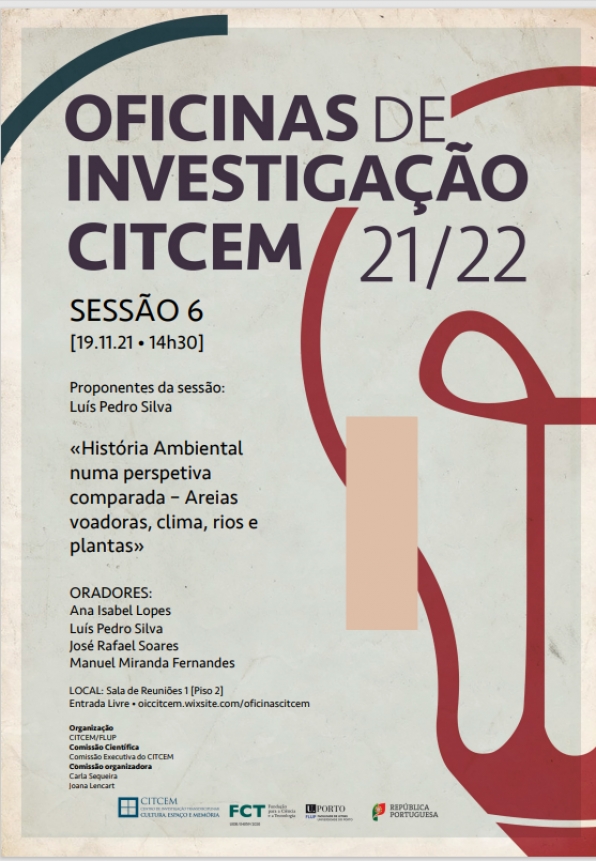
6.ª SESSÃO OIC 2021/22 «História Ambiental numa perspetiva comparativa – Areias voadoras, clima, rios e plantas»
Local: FLUP - Sala de Reuniões 1
Data: 19 Novembro 2021
Comunicações:
Ana Isabel Lopes - “Areias avoadiças” e vulnerabilidade das comunidades costeiras do noroeste português, na Época Moderna
Luís Pedro Silva - Clima e colheitas no Noroeste de Portugal: uma visão do passado à luz de dois diários beneditinos (1798-1830)
José Rafael Soares - As águas dos transgressores: estudo da história da poluição num afluente do Rio Ave (1892-1974)
Manuel Miranda Fernandes - “Acácias num carrossel”. Em torno da transferência fitogeográfica e da circulação de acácias na Região Mediterrânica
Videos of the presentations made in the 62nd Study Week "Environment and Infrastructures from the Early Modern Period to the Present":
New post on Herbarium World - Herbarium Metaphors by Maura Flannery
The last post in this series on books about herbaria is different from the others (1,2,3). It won’t focus on one book, but touch on many. What they have in common is their use of the word “herbarium” metaphorically; pressed plants are hardly mentioned, though they do come up in one book, Claudette Sartiliot’s (1993) work of literary criticism Herbarium Verbarium: The Discourse of Flowers. Herbarium here is used to signify all plants, not just dead ones. Sartiliot writes that she concentrates on modern and post-modern writers who use the flower “to reveal its polyvalent and extravagant nature, its verbal, psychological and botanical significances”.
Read more Herbarium World | Exploring herbaria and their importance (wordpress.com)
The HUM 952 STAND Group of the University of Granada resumes the celebration of the Congress of the Network of Environmental History of Spain (RUEDHA) in face-to-face or hybrid format in the city of Granada, from 11th to 13th May 2022 - "Pulling the Emergency Brake. Environmental History in the face of the Global Crisis".
III Congreso de la Red Española de Historia Ambiental-RUED(H)A. Granada, 11-13 Mayo 2022 – Stand UGR
Onde descobrimos que o célebre naturalista, químico e pensador económico Domenico (Domingos) Vandelli, fundador do primeiro jardim botânico nacional, o da Ajuda, era também um industrial da cerâmica. Não será assim tão surpreendente se considerarmos o interesse deste lente de Coimbra pelo aproveitamento dos recursos naturais endógenos, seja através (e principalmente) da agricultura, seja pela indústria. Assim disse: “as fábricas que merecem a maior atenção são aquelas que fazem uso das produções nacionais”. E assim fez, fabricando louça de notável qualidade e sucesso.